

(26 Mar 2025)
RESTRICTION SUMMARY:
ASSOCIATED PRESS
Pinar del Río, Cuba - 21 March 2025
1. Close of rice plantation
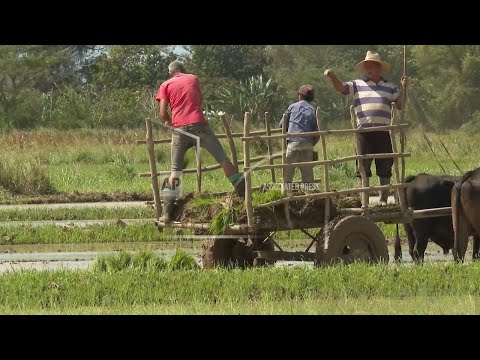
2. Various of farmers sowing rice as cart is pulled by oxen
3. Director of development for rice production in Pinar del Río, Nelson Gonzalez, speaking during interview
4. SOUNDBITE (Spanish) Nelson González, director of development for rice production:
“We are working with new economic actors (rice producers) in these areas that have better systems and that, provided they have better resources, will yield better results.”
5. Close of rice field
6. Various of farmer on a tractor plowing land
7. Rice farmer, Alfredo Sacre, speaking during interview
8. SOUNDBITE Spanish) Alfredo Sacre, rice producer:
“When you do not have what is needed because the country cannot import it, that is where the discontent (of the producers) begins. That is when one says: 'Why am I going to plant if the yield is so low?' For example, I used to be able to produce 5 tons (per hectare), and now I get much less - 2 and a half tons. That means half the income. Then you add the sun, the climate, the exposure to chemical products, risking one's health for so little - it is not worth it. So, one reduces their crops and sows just for personal consumption.”
9. Various of farmers planting rice
10. tracking shot of rice field
STORYLINE:
Cuba has for the first time in recent history authorized the use of land to a foreign company, hoping to yield better rice crops.
Despite the limited official information, it seems to be yielding positive results in its performance.
In January, the official newspaper Granma reported that Cuba had handed over 308 hectares of land in the western province of Pinar del Rio to a Vietnamese company.
It is unclear whether the land was leased or granted in usufruct, and the terms of the binational agreement remain unknown. However, it has been emphasized that the rice will stay in the country.
Early this month, a report by the official 'Guerrillero de Pinar del Río' newspaper made public that the experimental program indicated that 16 hectares cultivated by the Vietnamese with their own variety of rice achieved a yield of 7.2 per hectare.
This was later confirmed by the Vietnamese ambassador to Cuba, Le Quang Long.
In Cuba, each person on the island consumes an estimated 60 kilograms of rice per year, making it one of the highest rates in the region.
To meet its demand for the grain, the Caribbean nation requires approximately 600,000 tons annually, but in 2024, it barely managed to produce 80,000 tons.
Cuba went from yielding between four and six tons per hectare at the end of the last decade to producing just 1.7 tons per hectare in 2024, according to official figures.
Farmers say they need support, machinery, and a better price for rice.
"When you do not have what is needed because the country cannot import it, that is where the discontent begins," said Alfredo Sacre, who has been producing rice on his 40 hectares in Los Palacios for more than 15 years, .
"That is when one says: 'Why am I going to plant if the yield is so low?... So, one reduces their crops and sows just for personal consumption.”
AP Video by Ariel Fernández and Milexsy Durán
===========================================================
Clients are reminded to adhere to all listed restrictions and to check the terms of their licence agreements. For further assistance, please contact the AP Archive on: Tel +44(0)2074827482 Email: [email protected].
Find out more about AP Archive: http://www.aparchive.com/HowWeWork
Twitter: https://twitter.com/AP_Archive
Facebook: https://www.facebook.com/APArchives
Instagram: https://www.instagram.com/APNews/
You can license this story through AP Archive: http://www.aparchive.com/metadata/youtube/59d8d0fd586749e6a6570a1b0f4b187c
RESTRICTION SUMMARY:
ASSOCIATED PRESS
Pinar del Río, Cuba - 21 March 2025
1. Close of rice plantation
2. Various of farmers sowing rice as cart is pulled by oxen
3. Director of development for rice production in Pinar del Río, Nelson Gonzalez, speaking during interview
4. SOUNDBITE (Spanish) Nelson González, director of development for rice production:
“We are working with new economic actors (rice producers) in these areas that have better systems and that, provided they have better resources, will yield better results.”
5. Close of rice field
6. Various of farmer on a tractor plowing land
7. Rice farmer, Alfredo Sacre, speaking during interview
8. SOUNDBITE Spanish) Alfredo Sacre, rice producer:
“When you do not have what is needed because the country cannot import it, that is where the discontent (of the producers) begins. That is when one says: 'Why am I going to plant if the yield is so low?' For example, I used to be able to produce 5 tons (per hectare), and now I get much less - 2 and a half tons. That means half the income. Then you add the sun, the climate, the exposure to chemical products, risking one's health for so little - it is not worth it. So, one reduces their crops and sows just for personal consumption.”
9. Various of farmers planting rice
10. tracking shot of rice field
STORYLINE:
Cuba has for the first time in recent history authorized the use of land to a foreign company, hoping to yield better rice crops.
Despite the limited official information, it seems to be yielding positive results in its performance.
In January, the official newspaper Granma reported that Cuba had handed over 308 hectares of land in the western province of Pinar del Rio to a Vietnamese company.
It is unclear whether the land was leased or granted in usufruct, and the terms of the binational agreement remain unknown. However, it has been emphasized that the rice will stay in the country.
Early this month, a report by the official 'Guerrillero de Pinar del Río' newspaper made public that the experimental program indicated that 16 hectares cultivated by the Vietnamese with their own variety of rice achieved a yield of 7.2 per hectare.
This was later confirmed by the Vietnamese ambassador to Cuba, Le Quang Long.
In Cuba, each person on the island consumes an estimated 60 kilograms of rice per year, making it one of the highest rates in the region.
To meet its demand for the grain, the Caribbean nation requires approximately 600,000 tons annually, but in 2024, it barely managed to produce 80,000 tons.
Cuba went from yielding between four and six tons per hectare at the end of the last decade to producing just 1.7 tons per hectare in 2024, according to official figures.
Farmers say they need support, machinery, and a better price for rice.
"When you do not have what is needed because the country cannot import it, that is where the discontent begins," said Alfredo Sacre, who has been producing rice on his 40 hectares in Los Palacios for more than 15 years, .
"That is when one says: 'Why am I going to plant if the yield is so low?... So, one reduces their crops and sows just for personal consumption.”
AP Video by Ariel Fernández and Milexsy Durán
===========================================================
Clients are reminded to adhere to all listed restrictions and to check the terms of their licence agreements. For further assistance, please contact the AP Archive on: Tel +44(0)2074827482 Email: [email protected].
Find out more about AP Archive: http://www.aparchive.com/HowWeWork
Twitter: https://twitter.com/AP_Archive
Facebook: https://www.facebook.com/APArchives
Instagram: https://www.instagram.com/APNews/
You can license this story through AP Archive: http://www.aparchive.com/metadata/youtube/59d8d0fd586749e6a6570a1b0f4b187c
- Categoria
- Utilaje Agricole

Fii primul care comenteaza acest videoclip.
Up Next
-
22:40

YAMS 2026 ' Yorkshire Agricultural Machinery Show ' Is it time to go black?
-
07:32
DOPET Qatar Recruitment | Doha Petroleum Construction Company | Qatar Oil & Gas | Complete Company
-
26:23
Revolution in Agriculture - A Selection of The Most Successful Agricultural Machines
-
12:13
Revolution in Agriculture - A Selection of The Most Successful Agricultural Machines #15
-
00:19
Cultivating Land Machine Douyin Agricultural Machinery Popular.????
-
40:07
Use agricultural machinery to plow the land and plant corn - Return and Cleaning up the old house
-
09:02
Revolution in Agriculture - A Selection of The Most Successful Agricultural Machines #8
-
10:31
Revolution in Agriculture - A Selection of The Most Successful Agricultural Machines #20
-
13:03
Revolution in Agriculture - A Selection of The Most Successful Agricultural Machines #14
-
11:25
Revolution in Agriculture - A Selection of The Most Successful Agricultural Machines #9
-
34:23

CU 10.000 EURO POTI CONSTRUI O SUPERBA CASA IN 2023!Calcul materiale+manopera.
-
01:32

sonda de foraj td125 videle baicoi targ
-
02:34

Motocultoare cu remorca 4x4 bihor Utilaje agricole pentru gospodărie, cu livrare la domiciliu. Nibo
-
02:11

Troliu hidraulic Visoli 20.000 lb (9.080 kg)
-
47:04

Inside the Liebherr Factory ???????? | How Crawler Bulldozers Are Made?
-
05:34

Constructie cabana tip a Frame din panouri SIP / kit de structura / imagini de la montaj AFR0027
-
05:30

CAMIOANE DE GUNOI CU TOMBEROANE LUMINI SI SUNETE DE LA DRIVEN CITY SERVICE VEHICLE & SPEED TRACK
-
07:29

Excavator | Pipo si camionul sau de tractari , desene pentru copii ca Minecraft
-
00:55

Echipamente Utilaje (0754 390 689) - Extensie braț și cupă excavare albie râu - excavator șenile O&K
-
00:26

0754 390 689 - Braț și cupă excavare pentru utilaj telescopic CATERPILLAR.
 Loading...